

© Copyright Solvents Australia 2011



























SOLGAS
®
Refrigerants

Products & Information
Click links below
Refrigerant Technical Data


Solgas Australia is the partner company of Solvents Australia that markets reclaimed
refrigerants.
The range includes R22 and R134a, commonly used in domestic refrigeration and automotive
air-conditioning.
With the phaseout of R22 well advanced and the application of GWP carbon pricing,
Solgas Australia is able to supply reclaimed refrigerants at significantly reduced pricing. This allows
for the cost effective retention of existing equipment through to its economic lifespan without the need
for premature replacement or de-commissioning.
All Solgas reclaimed refrigerants are certified to comply with the ARI-700 Standard.


Products and Services














R-22 refrigerant, an HCFC, has properties providing for a broad range
of applications including residential air conditioning, refrigeration, and
other cooling applications. R-22 is going through a mandatory phase
out according to the schedule set by the Montreal Protocol. End-users
should consult their local wholesaler or refrigerant manufacturer for
more information on the R-22 phase-out.
Application:
R-22 is used in a variety of applications including residential and
commercial air conditioning, refrigeration, chillers, room air
conditioning, transport refrigeration and other comfort cooling and
refrigeration applications.
Properties & Performance:
R-22 has properties making it a useful refrigerant in many air
conditioning and refrigeration applications.R-22 is a single component,
non-flammable, non-toxic refrigerant with an A1 ASHRAE safety rating.
Lubrication:
R-22 works with mineral oil, alkylbenzene oil or POE oil.End-users
should check with the equipment manufacturers guidelines for specific
oil selection directions.
Charging:
Charging with R-22 can be done either as a vapor or a liquid. End-
users should check with their equipment manufacturers guidelines for
specific charging instructions.
R-22
Properties
R-22
Average Molecular Weight (g/mol)
86.5
Normal Boiling Point (°F)
-41.3
Critical Temperature (°F)
204.8
ASHRAE Safety Group Classification
A1
Ozone Depletion Potential (ODP)
0.055
Global Warming Potential (GWP)
1,500

R-404A refrigerant is a non-ozone depleting, near azeotropic blend of
HFC refrigerants R-125, R-143a and R-134a.
Application:
R-404A is formulated to closely match the properties of R-502, making
it useful for a variety of medium and low temperature refrigeration
applications. R-404A has been approved by many refrigeration
compressor and system manufacturers for use in new refrigeration
equipment such as food display and storage cases, cold storage
rooms, ice machines, transportation, and process refrigeration.
Properties & Performance:
R-404A is designed to meet the needs of many new and existing
refrigeration systems. R-404A is near azeotropic HFC refrigerant blend
rated A1 by ASHRAE (lowest levels of toxicity and flammability) having
zero ozone depletion potential.
Lubrication:
R-404A is immiscible with the traditional lubricants used in R-502
systems. As such, the original oil should be replaced with POE when
retrofitting to R-404A, and the presence of the old oil should be reduced
to 5% or less of the original charge. Failure to do so may result in
inadequate oil return or other system problems.
Charging:
Due to the zeotropic nature of R-404A, it should be charged as a liquid
to prevent fractionation (changes in refrigerant composition due to
vapor charging. See Definitions - Fractionation). In situations where
vapor is normally charged into a system, a valve should be installed in
the charging line to flash the liquid to vapor during charging. Testing
shows that fractionation due to system leaks is typically not a problem
for R-404A. Fix the leak and top off the charge.
Retrofit:
R-404A can be used to retrofit many existing R-502 systems. The
physical and thermodynamic properties of the blend cause it to behave
much like R-502 when used as a retrofit but it is not intended to be a
direct “drop-in” for R-502 systems. Due to higher operating pressures
associated with the use of R-404A as opposed to R-502, OEM product
specific retrofit recommendations should be consulted for any and all
pressure relief modifications and/or requirements.
R- 404A
Properties
R-404A
Average Molecular Weight (g/mol)
97.6
Normal Boiling Point (°F)
-51.5
Critical Temperature (°F)
161.6
ASHRAE Safety Group Classification
A1
Ozone Depletion Potential (ODP)
0
Global Warming Potential (GWP)
3,260

R-409A refrigerant (R-409A or FX-56) is a low ozone depleting blend of HCFC
refrigerants R-22, R-124, and R-142b. R-409A is formulated to closely resemble
the properties of R-12.
Application:
Applications include many medium temperature refrigeration systems, vending
machines, refrigerators, positive displacement chillers, humidifiers and other
systems using R-12 or R-500.
Properties & Performance:
R-409A has properties and performance similar to R-12 and R-500. Low side
pressures are similar to those of R-12, while high side pressures will typically be
15 to 25 psi higher. Equal or better heat transfer characteristics are usually
obtained when retrofitting from R-12 to R-409A
Lubrication:
R-409A works well with the MO or AB found in R-12 or R-500 systems, and
typically does not require an oil change. For low temperature, mineral oil based
R-12 applications (evaporator temperatures less than 0°F); a partial oil change
(less than 30%) to alkylbenzene is recommended. R-409A is fully miscible with
AB and POE oils.
Charging:
Due to the zeotropic nature of R-409A, it should be charged as a liquid to
prevent fractionation (changes in refrigerant composition due to vapor charging.
See Definitions- Fractionation). In situations where vapor is normally charged
into a system, a valve should be installed in the charging line to flash the liquid
to vapor while charging. Charging weight ratios of R-409A are usually 85 - 90%
of the charge weight of R-12.
Retrofit:
R-409A is the recommended retrofit for R-12 and R-500 stationary DX systems,
where an oil change to POE is not practical. R-409A is not recommended for
use in automotive air conditioning system, or systems that utilize a flooded
evaporator (i.e. centrifugal chillers). For these systems, R-134a is the
recommended retrofit product.
Retrofitting Procedures
1. Establish baseline performance. Note the oil type in use and any system
operating data (if system is operating properly). Check for existing leaks and
identify any needed repairs.
2. Recover the existing refrigerant charge (DO NOT vent to atmosphere).
Weigh the amount of refrigerant removed.
3. Perform any repairs identified in step 1 and fix any leaks.
4. Replace the filter-drier, and if necessary, elastomeric seals (O-rings. sight
glasses. etc.). Verify the condition of the system oil; replace if necessary.
5. Oil changes are typically not required for R-409A. For low temperature
mineral oil based systems, a partial (greater than 30%) oil change to AB is
recommended.
6. Evacuate the system (less than 500 microns) and insure it maintains a
vacuum. If vacuum is lost, it may indicate that leaks are present in the system.
7. Charge system with R-409A refrigerant. Remove refrigerant as liquid only
from cylinder. The initial charge amount should be approximately 85 – 90% of
the standard charge for R-12 for TXV systems, and 80 % for cap tube systems.
8. Adjust TXV set point and/or refrigerant charge to achieve the desired
superheat. Low side pressure control settings may also need to be adjusted.
9. Monitor oil levels in the compressor. If necessary, adjust oil amounts to attain
normal operating level (mid sight glass).
10. Label system clearly, indicating the type and amounts of system refrigerant
and oil.
R-409A
Properties
R-409A
Average Molecular Weight (g/mol)
97.4
Normal Boiling Point (°F)
-30.1
Critical Temperature (°F)
224.2
ASHRAE Safety Group Classification
A1
Ozone Depletion Potential (ODP)
0.05

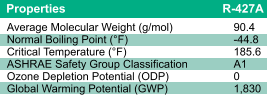
R-427A refrigerant is a non-ozone depleting blend of HFC refrigerants R-32, R-125, R-143a, and R-
134a. R-427A was developed as a retrofit refrigerant for many R-22 applications.
Application:
R-427A is an R-22 retrofit for low and medium temperature refrigeration and air conditioning systems.
Properties & Performance:
R-427A is designed to meet the needs of many new and existing air conditioning and refrigeration
systems. R-427A is a zeotropic HFC refrigerant blend, which is rated A1 by ASHRAE (lowest levels of
toxicity and flammability) and has zero ozone depletion potential. R-427A has comparable capacity
to R-22 and better efficiency than most other R-22 replacements. R-427A’s discharge temperatures
are typically 15 – 40°F lower than those of R-22, and it has one of the lowest global warming
potentials (GWP) of the R-22 retrofits.
Lubrication:
Mineral oil and alkylbenzene are often acceptable with R-427A if the system has an oil separator and
reliable oil return with R-22. Otherwise the oil must be changed to POE. If POE is required, usually
only one change-out of the existing lubricant is needed, as R-427A can tolerate high levels of
residual mineral oil or alkylbenzene remaining in the system.
Charging:
Due to the zeotropic nature of the R-427A blend, it should only be charged as liquid to prevent
fractionation (changes in the designed refrigerant composition, See Definitions - Fractionation). In
situations where vapor would normally be charged into a system, a valve should be installed in the
charging line to flash liquid from the cylinder into vapor. Never introduce liquid into a running system,
as compressor damage may result. Manifold gage sets, charging machines and tanks used with R-22
should be compatible for use with R-427A, provided they have been properly evacuated to prevent
mixing of the two gases.
Retrofit:
R-427A was developed to minimize the work necessary during an R-22 system retrofit: therefore,
retrofits to R-427A do not require change-out of expansion valves or other major components.
Expansion devices may need to be adjusted to optimize system performance.
Retrofitting Procedures
1. Establish baseline performance. Note the oil type in use and any system operating data (if system
is operating properly). Check for existing leaks and identify any needed repairs.
2. Recover the existing refrigerant charge (DO NOT vent to atmosphere). Weigh the amount of
refrigerant removed.
3. Perform any repairs identified in step 1 and fix any leaks.
4. Replace the filter-drier, and if necessary, elastomeric seals (O-rings, sight glasses, etc.). Verify the
condition of the system oil; replace if necessary.
5. Determine if an oil change is needed. If an oil separator is currently used and reliable oil return has
been established with R-22, replacement of original mineral oil or alkylbezene is often not needed
(skip to step 7). If no oil separator is present, drain existing mineral oil or alkylbenzene from the
compressor sump, suction line accumulators, etc. Record the amount of oil removed.
6. Add an equivalent amount of OEM recommended POE oil. In most cases, no flushing is required.
Only one oil change is required with up to 15% residual mineral oil or alkylben-zene accommodated.
7. Evacuate the system (less than 500 microns) and ensure it maintains a vacuum. If vacuum is lost,
it may indicate that leaks are present in the system.
8. Charge system with R-427A refrigerant. Remove refrigerant as liquid only from cylinder. The initial
weight should be approximately 95% of the standard charge for R-22, charging up to 100% if
necessary.
9. Adjust TXV set-point and/or refrigerant charge to achieve the desired superheat. Low side
pressure control settings may also need to be adjusted.
10. Monitor oil level in the compressor. If necessary, adjust oil amount to attain normal operating level
(mid-sight glass).
11. Label system clearly, indicating the type and amounts of system refrigerant and oil.
R-427A
Close

X

R-407C refrigerant is a non-ozone depleting blend of HFC refrigerants R-32, R-125 and R-
134a. It has been formulated to closely match the properties of R-22.
Application:
Applications include residential and commercial air conditioning systems, non-flooded
evaporator chillers, and some commercial refrigeration systems. Since R-407C has similar
properties to R-22, it is possible (with modifications) to use it in the same equipment designed
for R-22 today.
Properties & Performance:
R-407C is designed to meet the needs of many new and existing air conditioning and
refrigeration systems. R-407C is a zeotropic HFC refrigerant blend, rated A1 by ASHRAE
(lowest levels of toxicity and flammability) having zero ozone depletion potential.
Lubrication:
POE lubricants must be used with R-407C since its components are not miscible with the
mineral oil or alkylbenzene lubricants found in most R-22 systems. When retrofitting, a
lubricant flush procedure is necessary to reduce the original oil content below 5%. New R-
407C equipment will be charged with the OEM recommended lubricant, ready to use with R-
407C.
Charging:
Due to the zeotropic nature of R-407C, it should be charged as a liquid to prevent
fractionation (changes in refrigerant composition due to vapor charging. See Definitions-
Fractionation). In situations where vapor is normally charged into a system, a valve should be
installed in the charging line to flash the liquid to vapor while charging.
Retrofit:
R-407C can be used to retrofit existing R-22 systems in positive displacement, direct
expansion refrigeration and air conditioning equipment. R-407C should not be used in
centrifugal chillers or other equipment that uses a flooded evaporator due to its high
temperature glide.
Retrofitting Procedures
1. Establish baseline performance. Note the oil type in use and any system operating data (if
system is operating properly). Check for existing leaks and identify any needed repairs.
2. Recover the existing refrigerant charge (DO NOT vent to atmosphere). Weigh the amount
of refrigerant removed.
3. Drain existing oil from the compressor sump, suction line accumulators, etc. Record the
amount of oil removed. Add an equivalent amount of OEM recommended POE oil.
4. Recharge the system with the recovered R-22 charge and run the system (at least 1 hour)
to circulate the new lubricant.
5. Recover the R-22 charge again and check the residual oil content of the lubricant. The
amount of the original lubricant in the POE must be less than 5%.
6. Repeat steps 3 – 5, as needed, until the required oil purity level is reached. Once the oil
flushes are completed, standard maintenance should be conducted (i.e. filter-drier change,
leak repairs).
7. Evacuate the system (less than 500 microns) and ensure it maintains a vacuum. If vacuum
is lost, it may indicate that leaks are present in the system.
8. Charge system with R-407C refrigerant. Remove refrigerant as liquid only from cylinder.
The initial charge weight should be approximately 90% of the standard charge for R-22,
charging up to 95% if necessary.
9. Adjust TXV set point and/or refrigerant charge to achieve the desired superheat. Low side
pressure control settings may also need to be adjusted.
10. Monitor oil level in the compressor. If necessary, adjust oil amount to attain normal
operating level (mid-sight glass).
11. Label system clearly, indicating the type and amounts of system refrigerant and oil.
R-407C
Properties
R-407C
Average Molecular Weight (g/mol)
86.2
Normal Boiling Point (°F)
-46.1
Critical Temperature (°F)
187.2
ASHRAE Safety Group Classification
A1
Ozone Depletion Potential (ODP)
0
Global Warming Potential (GWP)
1,525
Close

X

R-410A refrigerant is a non-ozone depleting blend of hydrofluorocarbons (HFC)
R-32 and R-125 developed as a replacement refrigerant for air conditioning
applications currently designed for (HCFC) R-22. Due to the higher refrigerating
capacity and pressures of R-410A, it should not be used as a retrofit refrigerant
in R-22 equipment.
Application:
Forane® 410A refrigerant is used in new residential and commercial air
conditioning systems, heat pumps, dehumidifiers and small chillers. R-410A is
also being considered in some medium temperature refrigeration applications
as well.
Properties & Perfomance:
R-410A is a near-azeotropic HFC refrigerant blend that meets the industry’s
needs for many new air conditioning systems. R-410A has received an A1
safety rating from ASHRAE (lowest levels of toxicity and flammability) having
zero ozone depletion potential. R-410A is a higher pressure and capacity
refrigerant than R-22, requiring equipment and components specifically
designed to accommodate the resulting higher system pressures and lower flow
rates needed. Typical operating pressures of an R-410A system will be 50% to
60% higher than those in an R-22 system at comparable operating conditions.
R-410A also has significantly higher volumetric refrigerating capacity than R-22
under most operating conditions. This allows OEMs to manufacture equipment
of similar capacity and efficiency to R-22 in a smaller package.
Lubrication:
To ensure proper oil return, R-410A is typically used with polyolester (POE) oil.
The HFC components of R-410A are not miscible with mineral oil or
alkylbenzene. Manufacturers provide new R-410A systems and compressors
already charged with the appropriate lubricant. Care must be taken when
handling POE lubricants because they are hygroscopic, which means that they
can readily absorb moisture from the air. This is especially a concern when
handling POEs in humid environments. High levels of moisture in the system
can lead to oil degradation and system failure.
Charging:
Due to the zeotropic nature of the R-410A blend, it should only be charged as
liquid to prevent fractionation (changes in the designed refrigerant composition,
See Definitions - Fractionation). In situations where vapor would normally be
charged into a system, a valve should be installed in the charging line to flash
liquid from the cylinder into vapor. Never introduce liquid into a running system,
as compressor damage may result. R-410A requires the use of manifold gauge
sets, recovery machines and cylinders specifically designed and rated for its
higher pressures.
Retrofit:
Due to the significantly higher operating pressures and capacities of R-410A, it
should never be used as a retrofit for R-22 systems. R-410A should only be
used with equipment designed specifically for use with R-410A.
R-410A
Properties
R-410A
Average Molecular Weight (g/mol)
72.6
Normal Boiling Point (°F)
-61.6
Critical Temperature (°F)
162.0
ASHRAE Safety Group Classification
A1
Ozone Depletion Potential (ODP)
0
Global Warming Potential (GWP)
1,725

R-134a refrigerant is a non-ozone depleting HFC refrigerant with properties
very similar to R-12. It can be used both as a pure refrigerant in a number of
traditional R-12 applications and as a component in refrigerant blends targeted
to replace R-502 and R-22.
Applications:
Applications include automotive air conditioning, chillers, medium temperature
commercial refrigeration, refrigeration appliances, and transport refrigeration.
Compressor and system manufacturers are selling new equipment specifically
designed for R-134a. In addition Arkema’s laboratory testing and field trials
have indicated R-134a will work in the retrofit of many existing R-12 and R-500
installations.
Properties & Performance:
R-134a is designed to meet the needs of many air conditioning and medium
temperature refrigeration systems. R-134a is a single component refrigerant
rated A1 by ASHRAE (lowest levels of toxicity and flammability) having zero
ozone bdepletion potential.
Lubrication:
POE or PAG (polyalkylene glycol, auto only) lubricants must be used with R-
134a since it is not miscible with mineral oil or alkylbenzene lubricants found in
many systems. Special care must be taken when using POE or PAG oils due to
their hygroscopicity (moisture absorption) when left exposed to the atmosphere.
When retrofitting, a lubricant flush procedure is necessary to reduce the original
oil content below 5% of the total oil charge. New R-134a equipment will be
charged with the OEM recommended lubricant, ready to use with R-134a.
Charging:
Charging with R-134a can be done either as a vapor or a liquid. End-users
should check with their equipment manufacturers guidelines for specific
charging instructions.
Retrofit:
R-134a can be used to retrofit some existing R-12 systems including R-12
centrifugal chillers, semi-hermetic, reciprocating, and screw refrigeration
applications, industrial refrigeration plants, automotive systems and some
hermetic compressor applications.
When retrofitting R-12 systems to R-134a, it is necessary to replace the existing
lubricant with POE oil, except in some automotive retrofit applications, which
require PAG oil. In most cases the mineral oil or alkylbenzene oil levels must be
reduced below 5% of the new POE charge. Check with OEMs for any specific
recommendations regarding oils or procedures. Remove as much of the
existing lubricant as possible, add POE, and run the system on R-12 for some
time. When the residual oil concentration is appropriate, remove R-12, replace
the filter-drier, and charge R-134.
R-134a
Properties
R-134a
Average Molecular Weight (g/mol)
102.0
Normal Boiling Point (°F)
-14.9
Critical Temperature (°F)
214.1
ASHRAE Safety Group Classification
A1
Ozone Depletion Potential (ODP)
0
Global Warming Potential (GWP)
1,300

R-408A (FX-10) is a low ozone depletion potential blend of HCFC-22 and HFC
refrigerants R-125 and R-143a. R-408A provides a convenient and reliable
retrofit solution for medium- and low-temperature refrigeration systems now
using R-502. It has been blended to closely match the physical and refrigeration
properties of R-502. Don't mix R-408A with R-502 or use it to top off existing
systems.
R-408A has been proven in independent laboratory testing that it can save 8%
in energy cost compared to R-502. Compared to our competitor's products it
can save up to 20% in energy costs, so supermarkets and large energy users
find R-408A to be a very attractive retrofit solution.
Refrigerants used in the past were either single-component products or blends
having a small glide that behaved as a single component. For the most part,
blends having a small glide like R-408A will perform the same as an azeotrope
like R-502. Keep in mind that:
The temperature glide of R-408A is less than 1° F (0.6°C). This glide is usually
not noticeable compared to normal temperature changes due to pressure drops
across the tubing, for example. In general, manufacturers have not indicated
special considerations for low-glide blends in normal retrofit applications.
R-408A will not significantly change in composition due to fractionation.
However, there will be a slight difference in composition in the vapor phase,
which is in equilibrium with liquid, such as in a cylinder. Always transfer R-408A
as a liquid from the cylinder to charging equipment or systems.
Using R- 408A to Retrofit R-502 Systems
R-408A can be used in most existing R-502 installations, with the following
considerations:
Performance -- In most retrofit applications, the capacity and efficiency of R-
408A is slightly higher than R-502. The compressor, line sizes, and other
components will not need replacement and should operate the same.
Lubrication -- R-408A can be used with mineral oil or alkylbenzene oil.
Polyolester lubricants might also be suitable. Systems using R-502 and mineral
oil that show adequate lubricant return to the compressor can continue to use
mineral oil with R-408A. Alkylbenzene alone or in combination with mineral oil is
the best choice to improve lubricant miscibility and return to the compressor.
Consult the manufacturer's guidelines for additional recommendations.
Material Compatibility -- Check our retrofit literature and obtain
recommendations from equipment manufacturers regarding compatibility of
materials with R-408A. Replace any materials not acceptable for use with R-
408A. In general, materials compatible with R-22 can be used with R-408A.
Retrofit Procedures
Gather baseline data while the system is still operating on R-502.
Check the system for leaks to identify necessary repairs.
Recover and weigh existing R-502 charge.
If needed, remove mineral oil and replace with alkylbenzene or polyolester.
Replace filter driers.
Evacuate system using a deep vacuum (at least 250 microns).
Charge system with R-408A using liquid phase only. (Approximate charge will
be 75 to 85% of R-502 nominal charge.)
Properly mark and identify R-408A refrigerant charge for the retrofitted system.
Start system and adjust expansion device, if needed.
Note:
Some original equipment manufacturers (OEMs) may have different lubricant,
safety, or retrofit requirements. Consult OEM guidelines for details.
R-408A
Properties
R-408A
Average Molecular Weight (g/mol)
87.0
Normal Boiling Point (°F)
-47.9
Critical Temperature (°F)
182.6
ASHRAE Safety Group Classification
A1
Ozone Depletion Potential (ODP)
0.026
Global Warming Potential (GWP)
2,650

R- 507A refrigerant (R-507A) is a non-ozone depleting, azeotropic blend of HFC
refrigerants R-125 and R-143a. R-507 is blended to closely match the
properties of R-502, making it a good refrigerant for some medium and most
low temperature refrigeration applications.
Application:
R-507A is approved by compressor and system manufacturers for use in new
refrigeration equipment such as food display and storage cases, cold storage
rooms, transportation and process refrigeration.
Properties & Performance:
R-507A is designed to meet the needs of many new and existing refrigeration
systems. R-507A is an azeotropic HFC refrigerant blend rated A1 by ASHRAE
(lowest levels of toxicity and flammability) having zero ozone depletion
potential.
Lubrication:
R-507A is immiscible with the traditional lubricants used in R-502 systems. As
such, the original oil should be replaced with POE when retrofitting to R-507A,
and the presence of the old oil should be reduced to 5% or less of the original
charge. Failure to do so may result in inadequate oil return or other system
problems.
Charging:
R-507A should be charged in liquid phase to ensure the correct composition is
being used in the refrigeration system. In situations where vapor is normally
charged into a system, a valve should be installed in the charging line to flash
the liquid to vapor while charging. R-507A will require the use of manifold gauge
sets, recovery machines and recovery tanks specifically designed for its higher
pressures.
Retrofit:
R-507A can be used to retrofit many existing R-502 systems. However, it is not
intended to be a direct "drop-in" for R-502 systems. Due to higher operating
pressures associated with the use of R-507A as opposed to R-502, OEM
product specific retrofit recommendations should be consulted for any pressure
relief modifications and/or requirements.
R- 507A
Properties
R-507A
Average Molecular Weight (g/mol)
98.8
Normal Boiling Point (°F)
-52.8
Critical Temperature (°F)
159.8
ASHRAE Safety Group Classification
A1
Ozone Depletion Potential (ODP)
0
Global Warming Potential (GWP)
3,300

R- 407A (R-407A) refrigerant is a non-ozone depleting blend of HFC refrigerants R-32, R-125, and
R-134a. R-407A was developed as a retrofit refrigerant for some R-22 applications.
Application:
R-407A is a R-22 retrofit for medium and low temperature refrigeration systems. It is not intended for
air-conditioning applications, nor recommended for use in systems with flooded evaporators.
Properties & Performance:
R-407A is designed to meet the needs of many new and existing refrigeration systems. R-407A is a
zeotropic HFC refrigerant blend, which is rated A1 by ASHRAE (lowest levels of toxicity and
flammability) and has zero ozone depletion potential.
R-407A is a close match to R-22’s capacities and flow rates, making it well suited as a retrofit for R-
22 in supermarket and food storage applications. Additionally, R-407A is one of the more energy
efficient R-22 retrofit options available for refrigeration applications.
Discharge temperatures of R-407A will be noticeably lower than those seen with R-22. System
pressures for R-407A are higher than R-22, particularly in high ambient environments. Consult the
system or component OEMs for recommendations on how best to accommodate the changes in
operating pressures.
Lubrication:
As with many HFC blends, R-407A will require a change to polyolester oil (POE) to ensure reliable
oil return and circulation throughout the system. For systems currently using an oil separator,
multiple oil flushes may not be required.
Charging:
Due to the zeotropic nature of the R-407A blend, it should always be charged as a liquid to prevent
fractionation (changes in the designed refrigerant composition). For installations where vapor is
normally fed into the low side of a running system, a fl ash valve should be installed in the charging
line to prevent liquid from entering the compressor. When retrofitting from R-22 to R-407A, the new
charge weight will typically be 95 – 100 % of the original charge weight of R-22.
Retrofit:
In most cases, overall system capacities and efficiencies of an R-407A retrofit will be similar to those
of R-22. Differences in actual performance will depend largely on system design, operating
conditions, and ambient temperatures. Refrigerant flow rates for R-407A are often slightly higher
than R-22. Expansion valves that are operating properly with R-22 will typically not have to be
replaced. Slight expansion valve adjustments may be required to optimize system performance.
Operating pressures will be higher, and may require changes to cut-out settings and pressure relief
devices. Always consult the OEM for recommendations before performing any system retrofit.
Retrofitting Procedures
1. Establish baseline performance. Note the oil type in use and any system operating data (if system
is operating properly). Check for existing leaks and identify any needed repairs.
2. Recover the existing refrigerant charge (DO NOT vent to atmosphere). Weigh the amount of
refrigerant removed.
3. Perform any repairs identified in step 1 and fix any leaks.
4. Replace the filter-drier and, if necessary, elastomeric seals (O-rings, sight glasses, etc.). Verify the
condition of the system oil; replace if necessary.
5. R-407A is immiscible with mineral oil and alkylbenzene, and will require most of the original
system oil to be replaced. Drain existing mineral oil or alkylbenzene from the compressor sump,
suction line accumulators, etc. Record the amount of oil removed.
6. Add an equivalent amount of OEM recommended POE oil.
7. Evacuate the system (less than 500 microns) and ensure it maintains a vacuum. If vacuum is lost,
it may indicate that leaks are present in the system.
8. Charge system with R-407A refrigerant. Remove refrigerant as liquid only from cylinder. The initial
weight should be approximately 95% of the standard charge for R-22, charging up to 100% if
necessary.
9. Adjust TXV set-point and/or refrigerant charge to achieve the desired superheat. Low side
pressure control settings may also need to be adjusted.
10. Monitor oil level in the compressor. If necessary, adjust oil amount to attain normal operating
level (mid-sight glass).
11. Label system clearly, indicating the type and amounts.
R- 407A
Close

X